Why Your Business Feels Stuck and Why It’s Not the Reason You Think
Leadership blindspots can often lead to founders feeling stuck in their business, but we cover the ways to aid in leadership decision making.
Why calm is a competitive edge in leadership, many treat as luxury. Learn how stillness sharpens decisions, culture, and performance.
We are surrounded by chaos. Everything is urgent. Everything is a priority. Ten fires to put out, only for twenty more to spring up. Messages and emails around the clock. Chaos has become the new normal - but should it be?
For many, being constantly busy and needed is being worn like a badge of honor, as the mistaken proof of importance. Yet when we look closely, the most powerful people rarely rush. They are composed. Deliberate. Unhurried, even in an emergency. Their calm is almost unnerving. They understand that calm is not only the luxury that we should strive for, but also a powerful tool of strategic execution. One that can be built and one that is definitely worth reaching for.
Key insights:
Before we dive into the rest of the article, let us define what we mean by calm and clarity.
Calm, in our world, is a strategic advantage that impacts business, team, and individual people for the better.
It’s the leader’s ability to slow a situation down, think clearly under pressure, and choose the response instead of being dragged by emotion or urgency.
Calm is not the absence of speed; it’s the presence of command. To put it in other words, it’s the mastery of crisis management and risk management skills.
Clarity is knowing what matters, why it matters, and what happens next.
It removes noise, aligns decisions, and turns scattered effort into coordinated movement.
Clarity isn’t inspiration. It's a direction that people can act on.
If you’d like the deeper, expanded definitions we use across Ace: calm, clarity, blind spots, and more, you can read the full glossary here → [link].
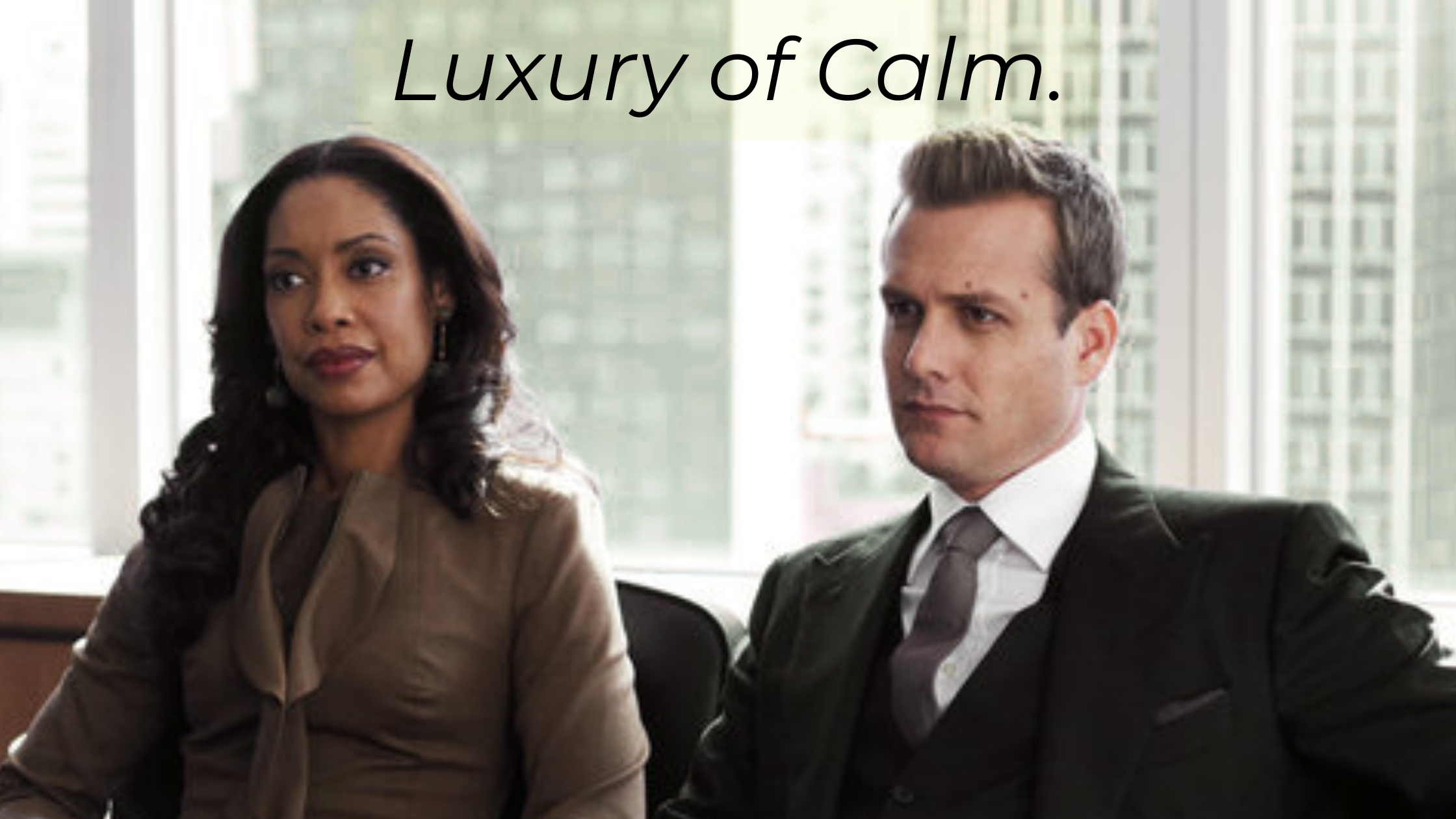
When we think of luxury, the images of rare cars, private islands, fine watches, names that whisper wealth come to mind. But luxury, in its truest form, was never (only) about possession. It's about the state it creates.
Luxury is refinement. Quality made conscious. It transforms. Not by excess, but by depth. It is the art of care made visible. It’s the quiet confidence that arises when something, or someone, has been shaped with intention.
Luxury, in its purest form, is the art of removing the unnecessary until only the essential remains. Allowing the essential to shine.
In a world addicted to noise, urgency, and constant motion, the truest marker of sophistication and of power is not how much you can do, but how calmly you can do it. The status symbol for the most powerful is peace of mind.
Calm is not the absence of intensity. Its intensity is refined. It is the ultimate hidden Ace in your sleeve: when you strip away the chaos, what remains is clarity. And from clarity, everything flows: time, space, results, energy. Calm doesn’t slow you down. It makes every move count. The irony is that what most people chase - more time, better performance, stronger teams - are all natural byproducts of clarity and composure. When you remove confusion, you remove waste. When you remove noise, you reveal insight. When you remove fear, you make space for brilliance. Calm is not a break from leadership. It is leadership in its most distilled, luxurious form.
Have you seen Suits? Jessica Pearson and Harvey Specter are the perfect example of calm under pressure. Whether they’re walking into a negotiation or a courtroom, they carry the kind of composure that unsettles everyone else. They rarely, if ever, look shaken.
Why? Because they’re prepared. They think five steps ahead. They anticipate what others might do, say, or attempt. Nothing catches them off-guard because they’ve already run the mental risk map in advance. Their calm isn’t a personality trait. It’s the product of strategy, foresight, and disciplined preparation.

Calm leadership is real leadership - and psychology proves it.
The human brain is wired for survival, not leadership. Under pressure, our biology defaults to fight, flight, or freeze. Adrenaline spikes, cortisol floods, and logic takes the back seat. This is useful when facing tigers. Not when facing deadlines. The best leaders learn to override that instinct. They retrain their nervous system to stay composed under threat. That’s why calm feels like power: it literally rewires perception.
Neuroscience (PMC, Academic) shows that emotion regulation significantly improves decision-making because it reduces the influence of irrelevant emotions on the choice you make. When people regulate their emotional state, even non-consciously, the brain’s decision-making regions (especially the prefrontal cortex) stay more stable, which leads to clearer evaluation of risks, more consistent judgement, and fewer impulsive or distorted choices. That’s why teams led by calm leaders report higher trust, faster recovery from crisis, and lower burnout. Clarity and calm aren’t just a nice thing to have or another buzzword. They are an operational advantage.
Biologically, our brains are wired for emotional mirroring: when we sense anxiety in a leader, we subconsciously prepare for threat. But when we sense composure, our system relaxes. Creativity rises. Collaboration becomes easier. Judgment sharpens. Investors read it as control. Competitors read it as strength.
The calmer you are, the more control you actually have. It’s not about appearing unbothered; it’s about being unbreakable. Calm comes from knowing what’s real risk and what’s just noise. That’s not luck. That’s skill. That’s risk management. That’s leadership.
So why is there still this confusion of motion for progress? Again, biology.
Every micro-win - a sent email, a crossed task, a ping answered - becomes a small hit of validation, a chemical illusion of control. The brain rewards these motions with a surge of dopamine, the neurochemical of doing. It feels like progress. It’s not. That same dopamine loop trains leaders to chase movement over meaning.
Biologically, chronic urgency forces the brain into tunnel vision.
When everything is on fire, the amygdala (the part responsible for fight or flight) takes the wheel. It narrows focus, spikes adrenaline, and cuts access to the prefrontal cortex (the area governing foresight, empathy, and strategy). You don’t think, you react. You don’t lead, you survive.
So what to us becomes the satisfactory chase of the completed tasks is in fact veiled chemistry of our brain tricking us.
That is why calm is not a mood. It’s a neurological advantage. When you slow down enough to access the prefrontal cortex, you unlock higher-order thinking: the ability to discern patterns, anticipate consequences, connect emotionally, and make decisions that age well. That’s what true leadership is made of. That is how you gain advantage over yourself and others.
The equation is simple:
Calm → activates clarity → drives intelligent action.
This is not wishful thinking; it’s neuroscience.
Leaders who can regulate their own nervous system create a ripple of stability through their teams. Their calm becomes a mirror that quiets everyone else’s panic. Meetings shorten, decisions sharpen, and people perform better. Not because they’re forced to, but because they feel safe enough to think.
And that is the paradox of modern power: we all participated in creating the grand illusion that a successful leader is loud and busy (often with being in everybody's business), yet the most successful and powerful ones are more quiet, calm, deliberate, & so much more impactful because of that.
If you are interested in exploring this topic further, here are a few articles that are worth exploring:

What allows the intentional leader to move with calmness is understanding the risk. In their mind, there’s an invisible map: what’s urgent, what’s worth attention, what can wait. It’s one of those skills that needs to become second nature, like breathing. Always being able to assess which risk is a threat, which is an inconvenience, and which is just a noise. That not only allows you to move with calm and peace of mind, but it also helps to avoid so many issues along the way. Once you assess what risk is there, you can prevent it before it happens. And while you may not get applause for heroically saving the day from the chaotic problem that blew out of proportion, the peace of mind, safe and productive team, and successful next level of business may just be reward enough.
Calm does not mean doing nothing. It means doing the right thing, at the right time, with the right energy. And this kind of precision can only come from clarity: clarity of priorities, clarity of systems, clarity of direction.
When a leader creates this kind of system, the entire structure breathes easier. Trust is built. Resources are used strategically, not reactively. Investors sense confidence without needing reassurance. And the leader themself has space to think.
It takes discipline to build this kind of environment. To resist the primal impulse to react when fear spikes. Our biology is wired for fight or flight. That’s why calm control is not luck. It’s a skill. One that fuses clarity of mind, strength of system, and emotional steadiness. It’s not something you’re born with. It’s something you build.
How can leaders begin to cultivate calm in their professional lives? Let’s apply it with 3 steps that take all of it from theory to behavior.
Most teams don’t collapse from overwork. They collapse from overwhelm. When everything is urgent and everything ‘needs to get done right now’ everyone is busy, everyone is overworked, yet there are no results. It's the leader's job to build a culture and system where people know: they know where are we going as a team and as a company, they know what is actually a priority and what is a nice to achieve, they know what decisions they can make, they know.
The point isn’t control. The point is trust. The kind that doesn’t need checking in, because it’s designed right from the start. Such system eliminates the need (or excuse) for micromanagement, supports successful delegation, and leads to achieving more with less stress, less resources wasted.
And when a fire breaks out (and it will) - stop.
Urgency is seductive. It ticks all the right triggers for our brain to make us jump to it and then feel good once we solve it. It’s dramatic, fast, and makes us feel important. But not every fire needs to be put down right now. Some things seem urgent, but really aren’t.
Some fires burn out on their own, some expose a weak point you should fix, and only a few truly need your attention. Knowing which is which saves time, energy, and morale.
Leadership calm doesn’t come from being detached. It comes from being deliberate.
In this article we are exploring the topic of urgency vs priority in depth → [link]
2. Build Systems That Think for You
If it lives only in your head, it’s not a system. It’s a single point of failure.
Write things down. Map them. Automate them. This isn’t about adding red tape; it’s about removing friction.
Systems don’t just make work smoother; they make leadership calmer. When clarity exists outside your head, the team stops depending on you for every answer. And starts building momentum on its own.
3. Delegate for Depth, Not Distance
Delegation isn’t dumping work; it’s building capacity.
Give people ownership, not chores. Let them understand why something matters, not just what needs doing.
When you delegate this way, you don’t lose control. You multiply competence. That’s how calm scales. We described the 7 steps to delegate like a pro to make the process of delegation easy and effective.
The modern leader’s biggest paradox is this: they crave and chase control, but what they truly need is clarity.
Control is reactive - the urge to fix everything by touching everything.
Clarity is strategic - knowing which few things actually matter, and letting the rest go.
When you shift from being a doer to an enabler, calm follows naturally. You no longer fight fires; you build systems that prevent them. You delegate not to escape work, but to multiply intelligence. You lead confidently and effectively without burning yourself or your team out. You have time for the projects and initiatives you always had to postpone ‘for later, when things calm down’ - but if you don’t, they never will.
In a world obsessed with hustle, stillness is the ultimate rebellion. And the ultimate advantage.
The most frustrating part is that for many executives and leaders, lack of clarity is structural, not personal, even if it feels this way. For example, did you ever feel the leader's decision making fatigue? That's one of the elements. Because of the leadership blindspots and organisational dynamics hidden in the structure of the business, there are plenty of ways to do everything right, and still fail. But that is what we work to make visible. Once we see what is going on under the surface, we can work it out.
Until next time,
-A.
If strategy execution keeps breaking down, it’s probably not your strategy.
It’s something shaping your business that you don’t fully see yet
and until you do, the same problems will keep coming back.
Start Your Mission with Mission X Ray →
See what’s actually driving outcomes,
and know exactly where to act to unlock execution.
→ Or our free Masterclass on Strategy Alignment (available on Youtube)
If this resonated, explore our broader library of insights and continue your journey:
Practical, story-driven insights from our video + article series. Clear continuation across topics: strategy, leadership, and patterns in action.
See full library on our Media page here or watch these and more on our Youtube: https://www.youtube.com/@agentatace
Leadership blindspots can often lead to founders feeling stuck in their business, but we cover the ways to aid in leadership decision making.
Explore the Ace glossary: practical, sharp, and leader-focused guidance for better decisions, healthier teams, and sustainable growth.
Decision fatigue in leadership quietly undermines executive decision making. Learn why constant choices exhaust leaders and how structural clarity...